
A tale of the first Malawi aquaponics system.


J.T on far left.
Last February I met J.T. Nelson when he visited Malawi. The original reason for his trip was to check out setting up a anesthesia department but that fell through. While we were sitting around the dinner table one night he asked if I knew anything about aquaponics and I said that I did and I was very interested in setting up a test site in Malawi to see viability of such a system. Comes to find out, J.T. is some sort of expert in aquaponics systems and he volunteered to help build the first one.
A little about aquaponics. Aquaponics is a cross between fish farming and hydroponics. Fish farming requires 30% of the water to be emptied every couple of days or ammonia will build up and cause the fish to die. Unless there is an ample supply of water, this is not feasible Hydroponics require a certain chemical balance and that means testing the water and having a the appropriate chemicals on hand. It also needs a filtration system so the roots of the plants don’t get nutrient lock.
Aquaponics combines the fish and plants in a recycling, closed loop system. The fish are kept in a tank and the water from the fish is pumped into a plant grow-bed The grow-bed is about 12″ deep and is filled with a media such as rocks or clay balls. A flood and drain or a “U” type drain is used to drain the water back into the fish tank. The water is allowed to rise to the surface in the grow-bed that brings nutrients to the plant roots. After the water has risen to a certain point the drain system causes a suction that draws all the water out of the grow-bed thus allowing the roots to dry out and not rot. The flow of water back into the fish tank is clean and by breaking the water surface tension of the fish tank, oxygen is given to the fish. The recycled water is clean of ammonia and nitrates because the plants and micro-organisms in the grow-bed convert the nitrates into nitrites. So, in a nutshell, the fish fertilize the plants and the plants clean the fish water; it’s a win-win.


In developed countries where materials and electricity is readily available an aquaponics system is easy enough to build. In Malawi, the situation is very different. The hardest part is the electricity. The pipes, pump, media, and sealant are also difficult to get. The other challenge is to build it cheaply enough for person living in a remote village to afford it.
So, with this in mind, J.T. set out to build us a concept aquaponics unit here at the African Bible College where we live. The system he designed is a 1000 gallon fish tank with 45 foot grow-bed made from bricks and concrete. The construction was simple enough but because of a short level that was out of level, the grow-bed was not level. In aquaponics it is imperitive that the floor of the grow-bed is absolutely level so it will drain all the way and not leave anaerobic dead spots. Since the grow-bed was out of level, J.T. had to level it and raise one end of the grow-bed by three inches. It took about a week but J.T. was able to source the pump and pipes needed so overall, the construction lasted about two weeks.


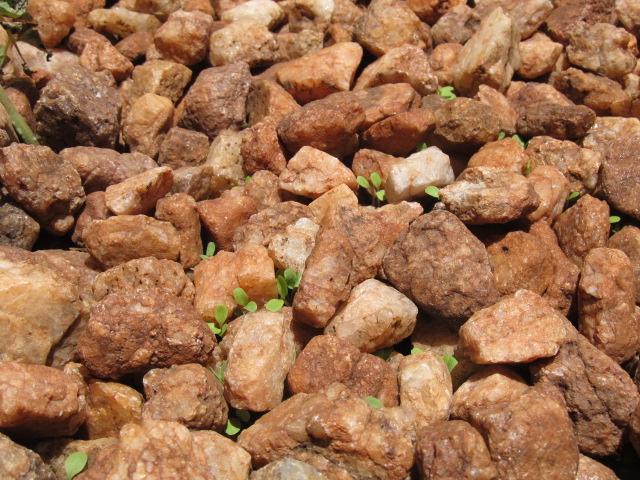
The media for the grow-bed has to be acid free so just any rock won’t do. The type of rock needed had to be trucked in from Salima which is an hour away. It took four trucks full of rock so the cost was quite high but eventually the rocks were loaded into the grow-bed and we were ready for fish and plants.
The fish were then our next hard to find item. We searched high and low for tilapia fingerlings and eventually found them a little ways out of town. Dyton was sent with Dennis to buy 350 fish. Once the fish were placed in the tank we transplanted a bunch of lettuce starts and then waited and watched to see if the system would kick off. It takes about six weeks for a new system to come balance for the good and bad organisms and a full year for the micro-organism colony to move in completely.
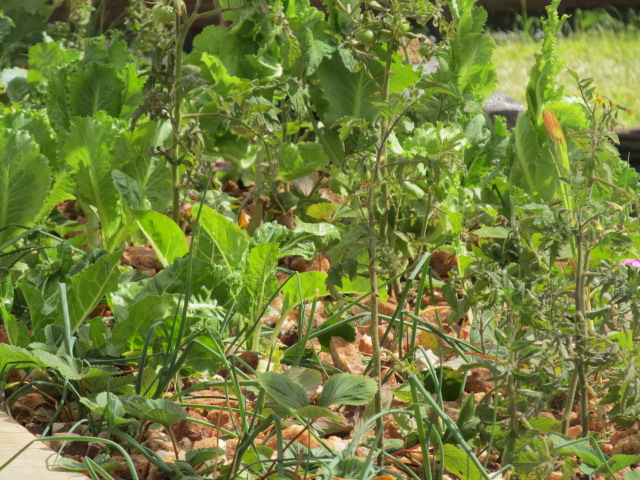
At first, the system did very well. The fish and plants were growing at a very fast clip. In an aquaponics system, plants can be planted up to four times as dense as a garden and because of the constant fertilizer the plants can grow up to 50% faster than ones in a soil garden plot. Four times more dense and 50% faster equals a lot of plants. The nice thing about tilapia is that they will eat lettuce, roots, and algae so food costs can be kept very low due to growing the feed yourself.
Utter fish and plant nirvana right? Well, not exactly. Problems started cropping up right away. First, the flood and drain system was really hard to dial in because of too small of pipes. Second, the fill and drain of the water was way off because of the packed media. The water would fill on one end and not get to the drain evenly and then the system would drain on one end and not the other. And then there was the amount of cracking in the concrete that let all the water out every week thus preventing the system to ever get in balance. Yikes!!!!

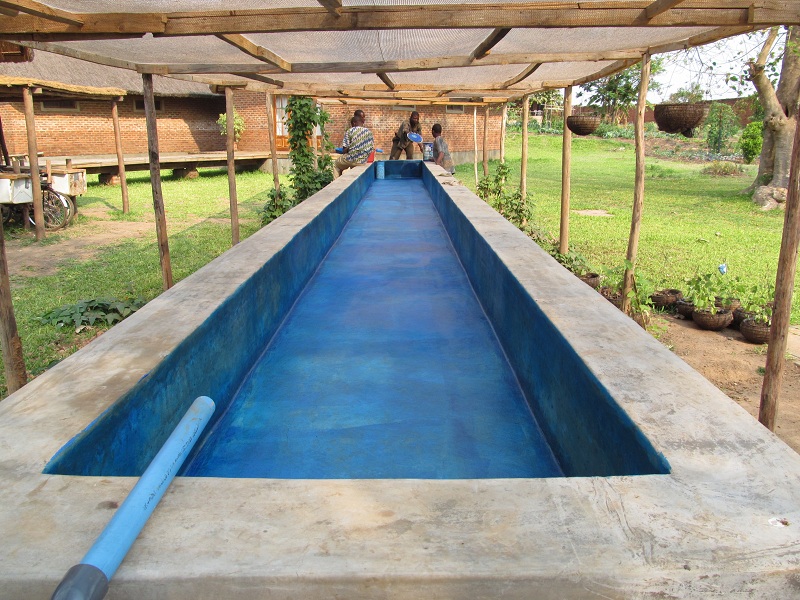
So, in the end we decided to wait until the fish matured to the point of harvest and then tear down and reset the system. After about eight months it was time to start the reset. First we harvested the fish only to find out only a few were tilapia and the rest some unknown mini-me fish. At least the workers got a small meal out of it. Then, after the system was drained we removed the media and dried the whole system out. I had bought some rubberized paint from the states that is good for sealing concrete cracks so Dennis and the crew put four coats of paint on the concrete. To solve the uneven drain problem we installed four parallel pvc pipes with holes drilled in them to increase the flow at the bottom of the grow-bed.

After the paint was dry and pipes installed we filled the grow-bed back up with rock and then filled the whole thing was filled with water. Dennis was able to find real tilapia at the agriculture college in Bunda for a great price. So after he and Dyton went and picked them up we installed the fish and waited again to see what would happen.


This time the system worked and is working very well right up to now. J.T. returned a month ago to help build a system in Gusu and was impressed at how well the system was working. His only tweak was to add another 300 fish because the nutrient level for the plants was to low and the system needed more ammonia. Now, lettuce, tomato’s, cucumbers, herbs, and flowers are growing like there is no tomorrow. In a couple of months we will harvest the first round of fish. Looks like we may have a winner if we can get a decent setup to work out in the village.
 e3worldwide
3 Responses to “A tale of the first Malawi aquaponics system.”
“in science and in medicine, I was a stranger you took me in.”
pretty cool
Reblogged this on Creative Resources, Bangladesh.